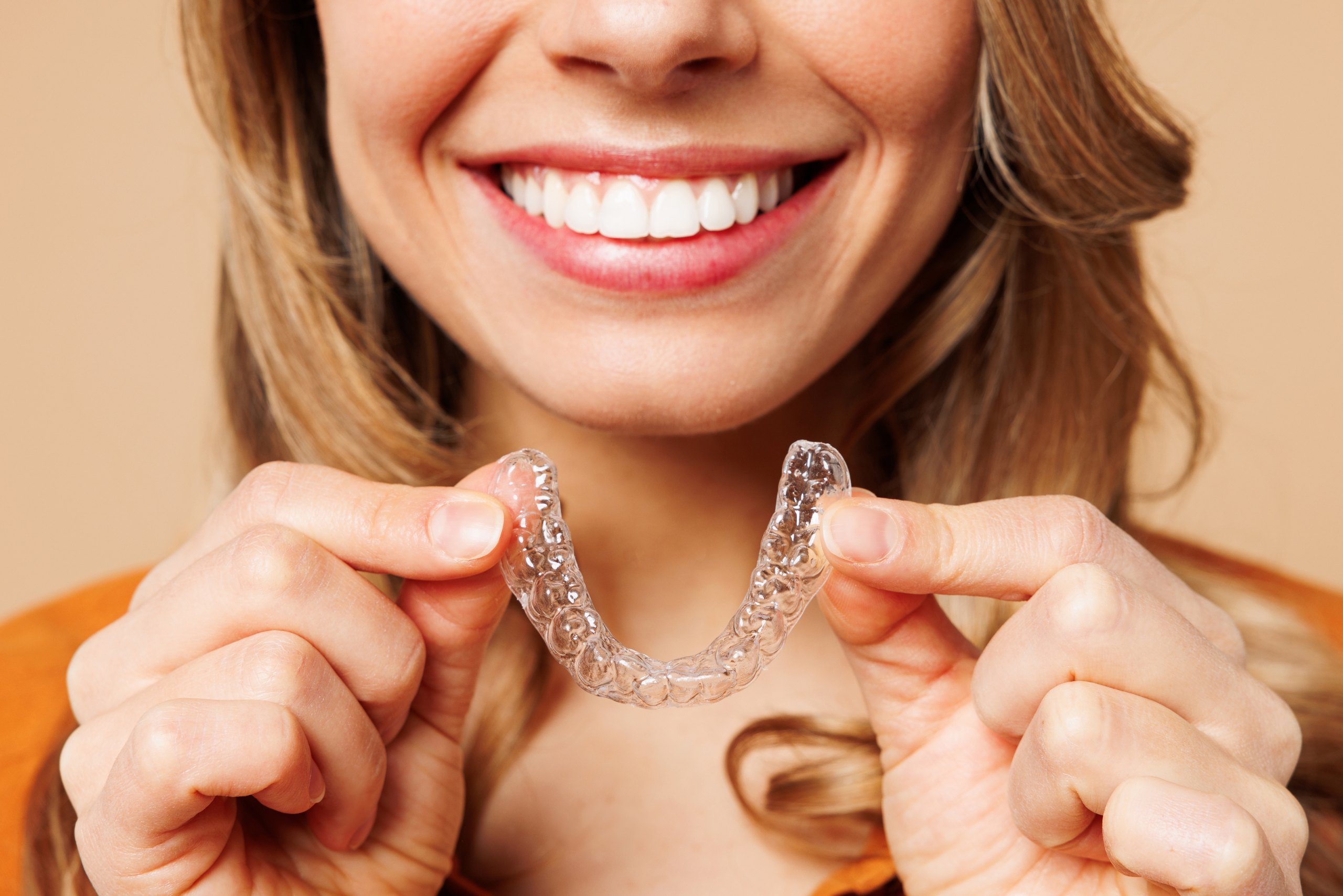
Types of Invisalign Treatment
Invisalign offers several treatment options designed to match the complexity of your case:
- Invisalign Full/Comprehensive — The most common and extensive form of Invisalign treatment. Used to correct moderate to severe orthodontic problems, including significant crowding, spacing, and bite issues. There is typically no limit on the number of aligners needed, allowing for full orthodontic treatment and complex tooth movements.
- Invisalign Lite — Designed for minor orthodontic problems, such as slight crowding or spacing, or minor relapse from previous brace wear. This option uses fewer custom-made aligners (typically up to 14) and generally has a shorter treatment time.
- Invisalign Express — Used for very minor corrections, like closing small gaps or fixing slight shifts. The shortest and least expensive option, utilizing fewer than 10 aligners.
- Invisalign for Teens — Features specifically for younger patients, including compliance indicators (small blue dots that fade with wear) and eruption tabs to accommodate teeth that have not fully emerged.
Who Qualifies for Invisalign?
Most people seeking to straighten teeth without braces are candidates for Invisalign clear aligners. Ideal candidates typically include:
- Adults and Teens — Invisalign is highly effective for both age groups, addressing common issues like crowded teeth, gaps, overbites, underbites, and crossbites.
- Individuals with Good Oral Health — Patients must be free of active gum disease or significant untreated decay before beginning treatment. Excellent oral hygiene is essential during the process.
- Those Seeking a Discreet Option — Anyone prioritizing aesthetics and comfort over traditional metal brackets often finds Invisalign to be the best of the available teeth straightening options.
- Patients with Moderate to Complex Needs — While the Lite and Express options handle minor movements, the Comprehensive plan can often address bite issues that were once thought to require traditional braces.
Benefits of Invisalign Clear Aligners
Choosing Invisalign offers a compelling array of benefits that traditional braces simply cannot match, making it a popular choice for patients of many ages:
- Virtually Invisible — Made from a clear, medical-grade plastic, clear aligners are barely noticeable, allowing you to straighten your teeth with confidence.
- Comfortable — Without metal wires or brackets to irritate your cheeks and gums, Invisalign offers a much more comfortable experience.
- Removable — Because the aligners can be removed before meals, this means no dietary restrictions and easy maintenance.
- Effective — Invisalign can correct a wide range of orthodontic issues, including crowded teeth, spaced teeth, crossbites, overbites, and underbites.
- Predictable Results — Our advanced 3D planning software allows you to visualize your treatment journey from start to finish.
- Fewer Office Visits — While regular check-ups are necessary, Invisalign typically requires fewer and shorter office visits compared to traditional braces, as there are no wires to tighten or adjust.
How Do Invisalign Aligners Work?
Invisalign clear aligners operate on the principle of gradual, controlled force. The aligners are made from an elastic thermoplastic material, which allows them to apply gentle pressure to move teeth effectively. Here is the process:
- Digital Planning — Advanced 3D imaging maps the current position of your teeth and precisely plots their final position.
- Staging — The software calculates the necessary intermediate steps, or stages, for your teeth to move from start to finish.
- Fabrication — A series of custom-made clear aligners is fabricated, each representing one tiny movement in the overall progression.
- Controlled Force — Each aligner is slightly different from the previous one. When you place a new tray over your teeth, it exerts gentle, consistent pressure to push the teeth into the aligner's new shape.
- Sequential Movement — You switch to a new set of Invisalign trays every one to two weeks, continuing the sequential movement toward the goal.
- Attachments (Buttons) — Small, tooth-colored bumps called "attachments" or "buttons" are often bonded to your teeth. These give the aligners something to grip, allowing the system to exert more complex rotational or vertical movements.